






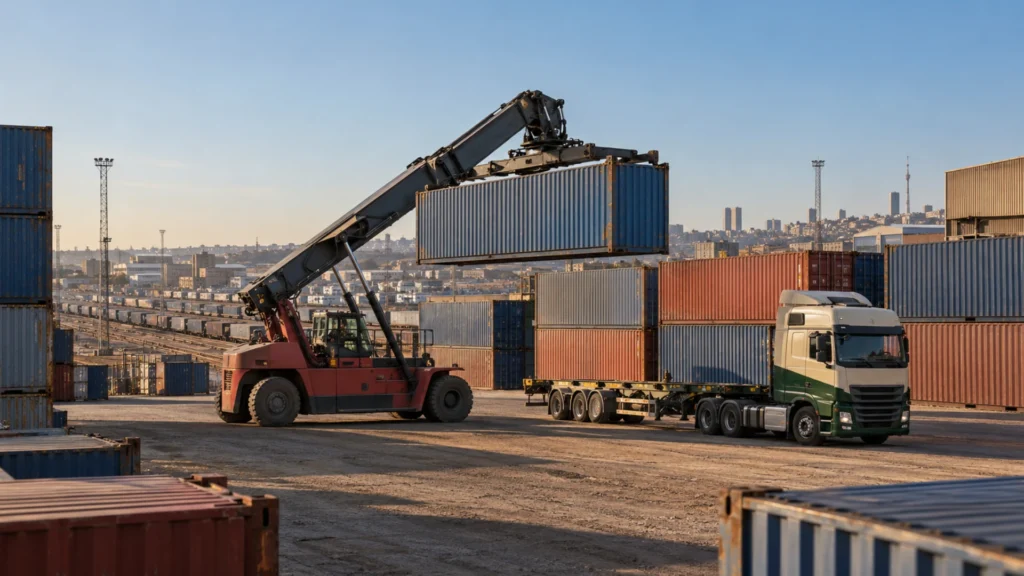
A City Deep container depot sits at one of the busiest junctions in South Africa’s supply chain. Most import containers bound for Gauteng leave the Port of Durban by rail or road and end up in or around City Deep, the inland container terminal in Johannesburg, before they reach a warehouse, a factory floor or a customer.
For importers, clearing agents and freight forwarders, the choice of depot near City Deep affects how quickly a container can be collected, where customs examinations take place, how long a box can wait before it becomes expensive and how smoothly the empty container goes back to the shipping line.
This guide explains what City Deep is, how containers travel there from Durban, what a customs-licensed container depot actually does, and how importers can plan around customs stops, bonded moves and storage deadlines.
Quick answer: A City Deep container depot is a facility close to Transnet’s City Deep inland terminal in Johannesburg that receives, stores, unpacks, examines and repositions containers. A SARS-licensed depot can also hold containers that are still under customs control, host customs examinations and store uncleared cargo until release.
What Is City Deep?
City Deep is Transnet’s inland container terminal in Johannesburg, often described as a dry port because it handles containers far from the coast. It was established in 1977 and is operated by Transnet Freight Rail.
When Transnet completed an R800 million upgrade of the terminal in 2015, the government news agency SAnews described City Deep as “Africa’s biggest inland port” and reported that the upgrade doubled its capacity to 400 000 TEU a year. The same report said the terminal could load and offload up to 10 trains a day between Durban and Johannesburg.
Transnet describes its container corridor as “the backbone of South Africa’s overall rail freight network” and lists City Deep alongside Kascon, Pretcon and Kaalfontein as inland terminals on that corridor, according to Transnet’s corridor overview.
Why City Deep Matters to Gauteng Importers
Gauteng is South Africa’s largest consumer and manufacturing market, but it has no seaport. Imported containers therefore need a landside link between the coast and the inland economy, and City Deep is the main hub for that link. Depots, warehouses and transport operators cluster around it because proximity reduces truck travel time between the terminal and the next step in the supply chain.
How Do Import Containers Get From Durban to City Deep?
Import containers travel from the Port of Durban to Gauteng in two main ways: by rail on the Natcor line to an inland terminal such as City Deep, or by truck on the N3 highway directly to a depot, warehouse or consignee.
Rail on the Natcor Corridor
Rail moves containers in bulk between Durban and City Deep. It can reduce the number of trucks on the N3 and suits steady, high-volume flows. Containers that arrive at City Deep by rail still need a truck for the final leg to a depot, warehouse or customer, which is where local cartage operators come in.
Road on the N3
Road transport takes containers directly from the Durban terminals to their destination. It offers more flexibility for urgent, time-sensitive or high-value cargo and avoids an extra handling step at the inland terminal.
| Factor | Rail via City Deep | Road on the N3 |
|---|---|---|
| Route distance | About 690 km by rail | About 550 km by road |
| Share of corridor freight | A minority share of Durban–Gauteng container traffic | Road carries about 87% of N3 corridor freight |
| Final delivery | Needs a truck from City Deep to the depot or customer | Door-to-door in one move |
| Best suited to | Steady, high-volume, less urgent flows | Urgent, high-value or time-sensitive cargo |
The distance and road-share figures come from a Freight News report from August 2026 quoting the Road Freight Association. Business Day reported in October 2025 that rail moves less than 14% of Durban–Gauteng container traffic, citing a private inland-port proposal.
What Does a City Deep Container Depot Do?
A City Deep container depot handles containers between the inland terminal and the importer’s own premises. Its services usually include the following:
- Collecting full containers from City Deep and delivering them to the depot or customer
- Storing full and empty containers, including overstays awaiting release
- Unpacking (destuffing) and packing (stuffing) containers
- Hosting customs and other regulatory examinations
- Staging reefer containers on plug points
- Repositioning and returning empty containers to shipping lines
- Container inspection, cleaning and repair
The difference between an ordinary container yard and a customs-licensed depot is significant. The South African Revenue Service licenses container depots under section 6(1)(hB) of the Customs and Excise Act for the “storage, detention, unpacking or examination of containers or the contents of containers”, according to SARS depot licensing guidance. A licensed depot can therefore receive containers that are still under customs control, which an ordinary yard cannot.
The difference between a container depot and a warehouse matters here too. A depot is built around container handling, while a warehouse is built around storing and distributing goods once they leave the box.
How Do Customs Stops and Examinations Work Near City Deep?
A customs stop happens when SARS selects a consignment for inspection before release. According to SARS inspection guidance, a customs inspector may stop, detain and examine any goods while they remain under customs control, and selection is communicated through a CUSRES code 2 message and a case on the SARS Service Manager.
Once a container is stopped, it has to be taken to a place where the examination can happen. Examinations can range from a quick tailboard check at the container doors to a full unpack of the cargo. Shipping & General explains the process in more detail in its guide to what happens during a customs examination.
Why the Depot Choice Affects Examination Time
A depot with its own examination team, handling equipment and transport can move a stopped container, prepare it for the inspector and repack it after the examination without waiting for outside resources. Shipping & General’s depot conducts tailboard, tunnel and full unpack inspections and sends clients a daily status report until final release.
The 28-Day Clearance Window
SARS gives importers 28 days to clear goods held in a container depot. Goods that remain uncleared after that period may be moved to a State Warehouse, according to SARS import guidance. Importers who expect documentation problems should raise them early rather than let the clock run down.
Moving Uncleared Containers: Removal in Bond
Containers that are still under customs control cannot travel on any truck. SARS states that all carriers that convey bonded cargo by road must be licensed, and that the carrier’s security must cover the duties and taxes on the goods it carries at any given time, according to SARS remover of goods guidance.
This is why the transporter and the depot need to work together. A licensed remover of goods in bond can collect an uncleared container from City Deep and deliver it to a licensed depot for examination or storage without breaking customs control. Shipping & General holds a remover of goods in bond licence and explains the rules in what is a remover of goods in bond and how to legally transport bonded cargo.
Why Does Depot Location Near City Deep Matter?
Every kilometre between the inland terminal and the depot adds truck time, fuel and exposure to traffic delays. A depot close to City Deep can complete more container moves per truck per day, which helps when many containers become available at once or when a free-time deadline is close.
Location also affects how quickly an importer can respond to a customs stop, a late release or a change in delivery plans. Shipping & General’s customs-licensed depot in Germiston sits roughly 5 km from City Deep, and the company holds port permits that allow its own fleet to collect and deliver containers at the terminal.
Handling Equipment and Capacity
Depot capacity depends on land and equipment as much as on location. Shipping & General’s depot runs full-container reach stackers and empty-container handlers on a facility of about 65 000 square metres, with 20 reefer plug points for staging refrigerated containers over weekends and public holidays.
A Planning Checklist for Gauteng Importers
Importers who use City Deep can reduce delays and extra charges by preparing before the container arrives:
- Confirm whether the container will travel by rail to City Deep or by road on the N3.
- Book collection capacity before the container becomes available, not after.
- Check the shipping line’s free time for demurrage and detention.
- Choose a customs-licensed depot in advance in case SARS stops the container.
- Make sure the transporter holds a remover of goods in bond licence if the box may move uncleared.
- Confirm receiving capacity at the warehouse or factory.
- Check the shipping line’s current empty turn-in depot before returning the container.
For a wider view of cost exposure, see Shipping & General’s guide to avoiding container demurrage charges.
What Is Changing on the Durban–Gauteng Corridor?
The rail side of the corridor is opening to private operators. In August 2025, eleven private operators received conditional access to the national rail network, four of them on Natcor, and one planned a Durban–City Deep container service for between the third quarter of 2026 and the first quarter of 2027, according to Railway Gazette.
Planned maintenance still interrupts rail capacity. The South African Association of Freight Forwarders flagged a Natcor maintenance shutdown from 25 August to 2 September 2026, as reported by Freight News. When rail capacity drops, more containers move by road, and depot and trucking capacity near City Deep comes under pressure.
Port-side congestion also flows inland. Shipping & General’s Durban port congestion guide for importers explains how delays at the coast affect collection and delivery plans in Gauteng.
Frequently Asked Questions About City Deep Container Depots
What is City Deep?
City Deep is Transnet’s inland container terminal in Johannesburg. It handles containers railed from coastal ports such as Durban and serves as the main inland hub for Gauteng container traffic.
What does a City Deep container depot do?
A City Deep container depot collects, stores, unpacks, packs, examines and repositions containers close to the inland terminal. A SARS-licensed depot can also hold uncleared containers and host customs examinations.
Can a container under customs control go to any depot?
No. A container under customs control must go to a facility licensed by SARS for that purpose and must be moved by a licensed remover of goods in bond or another carrier permitted by customs rules.
How long can goods stay uncleared in a container depot?
SARS gives importers 28 days to clear goods held in a container depot. Goods left uncleared after that period may be moved to a State Warehouse.
Is rail or road better for moving containers from Durban to Gauteng?
It depends on urgency and volume. Rail suits steady, high-volume flows into City Deep, while road on the N3 offers direct, flexible delivery for urgent or high-value cargo.
Where is Shipping & General’s depot relative to City Deep?
Shipping & General operates a SARS-licensed customs container depot in Germiston, roughly 5 km from City Deep, and holds port permits to collect and deliver containers at the terminal.
Need a Container Depot Close to City Deep?
Shipping & General operates a SARS-licensed customs container depot in Germiston, roughly 5 km from City Deep, with its own container haulage fleet, reach stackers and a licence to remove goods in bond.
Speak to the Shipping & General team about City Deep cartage, customs examinations, overstay storage or packing and unpacking for your next import.