


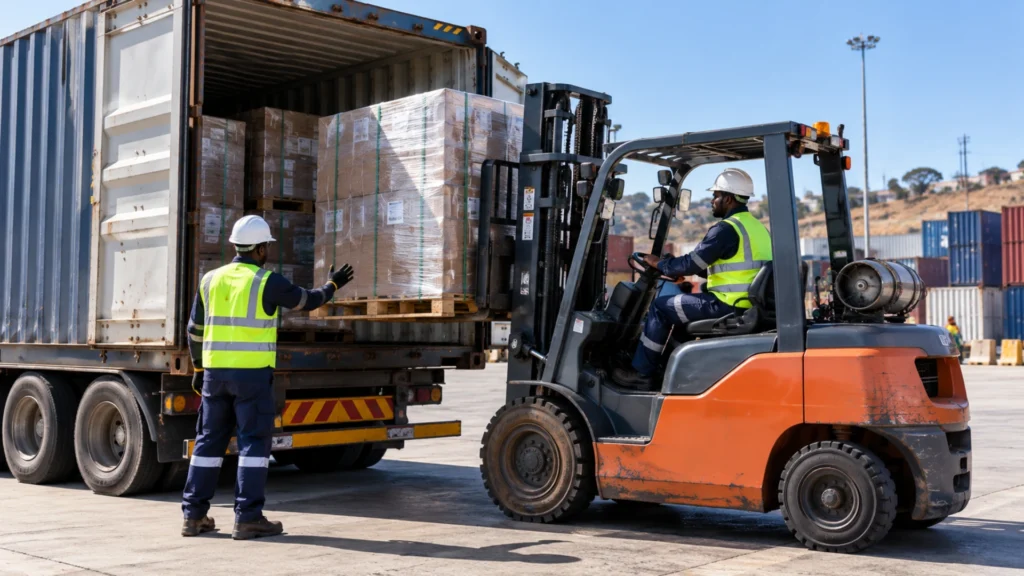
Container unpacking is the point where an import shipment stops being a sealed box and becomes pallets, cartons, drums or machinery that someone has to handle, count and deliver. For many Gauteng importers, that step happens at a container depot near City Deep rather than at their own premises.
The reasons are practical. Not every warehouse has a loading dock, a forklift that can reach into a 40ft container, or space to stand a container for a day. Some cargo is still under customs control when it arrives inland. And some containers are stopped for a customs examination that involves taking the cargo out.
This guide explains how unpacking and packing work in Johannesburg, what SARS allows at a licensed depot, how examinations fit in, what good practice looks like, and how to prepare so the job is quick and the empty container goes back on time.
Quick answer: Container unpacking, also called destuffing or stripping, means removing cargo from a shipping container for storage or delivery. In Johannesburg it is often done at a container depot near City Deep. A SARS-licensed depot can also unpack goods that are still under customs control, store them and deliver them once released.
What Is Container Unpacking?
Unpacking, destuffing and stripping all describe the same job: opening a container, removing the cargo safely and recording what came out. Packing, or stuffing, is the reverse, usually for exports.
The work sounds simple, but the details vary widely. Palletised cargo can usually come out with a standard forklift. Loose-loaded cartons, drums, paper reels, steel or out-of-gauge machinery each need different equipment, more labour and more time. The way the cargo was packed at origin largely decides how hard it is to get out.
A good unpack is also a record. Before the doors open, the seal number should be checked against the shipping documents. As cargo comes out, it should be counted against the packing list, and any damage, wet packaging or shortages noted and photographed. That record is what an importer needs if there is a claim against the supplier, the shipping line or an insurer, and it is very hard to recreate once the cargo has been delivered and mixed with other stock.
Where Can a Container Be Unpacked in Johannesburg?
Importers usually choose between three options, depending on their premises, the cargo and its customs status.
| Option | Works best when | Points to check |
|---|---|---|
| Unpack at your own premises | You have a dock or suitable forklift and space for the truck | Access for a container truck, time the truck waits, labour on site |
| Container grounded at your premises | You have no dock but can unpack at ground level | Sideloader availability, level hard standing, return date for the empty |
| Unpack at a container depot | Cargo is loose, heavy or still under customs control, or you need it delivered in smaller drops | Customs licence, handling equipment, storage and delivery options |
SARS approves container depots under section 6(1)(hB) of the Customs and Excise Act, at places listed in rule 200.08. According to the SARS depots page, they are used for “storage, detention, unpacking or examination of containers or the contents of containers”, and the licensee’s activities include packing containers for export.
How Does Customs Affect Container Unpacking?
Customs status decides where and when a container can be opened. Two situations matter most for Gauteng importers.
Unpacking Before Customs Clearance
This is possible at the right facility. A customs-licensed depot can receive and unpack cargo that is still under customs control, then hold it until SARS releases it. This can free the container for return sooner, which helps limit detention charges while clearance is still in progress.
Moving uncleared cargo from the port or terminal to the depot is a bonded movement. SARS states that carriers who transport bonded cargo by road must be licensed as removers of goods in bond. Our guide to the remover of goods in bond explains how that licence works.
Customs Examinations That Need an Unpack
SARS can stop a container at any point while it is under customs control. According to the SARS inspection page, a customs inspector may “stop, detain and examine any goods while under Customs control”. Inspections may be non-intrusive, such as a scan, or intrusive, and may lead to a full unpack of the consignment.
Three details from SARS matter for importers:
- The client must book a physical inspection through a dedicated email address.
- Packages may be opened and examined in the client’s absence, at the risk and expense of the client.
- Further action can follow an inspection, including a full unpack.
Because the importer carries the risk and expense of an examination, it pays to have it done where handling equipment and labour are already on hand. Our article on what happens during a customs examination covers the process in more detail.
How Should a Container Be Unpacked Safely?
The international reference for packing and unpacking is the CTU Code, a non-mandatory code of practice developed by the IMO, the ILO and UNECE and endorsed in 2014. Its advice on receiving and unpacking containers includes:
- Be aware that the atmosphere inside a container may be dangerous, and ventilate it before entering.
- Open the doors with caution, because cargo might fall out.
- Look for a fumigation mark, which the packer should fit if a fumigant was used.
- Return the container to the operator completely empty and clean, unless otherwise agreed.
Equipment and operators matter as much as procedure. Under regulation 18(11) of the Driven Machinery Regulations, 2015, the user may not permit anyone to operate a lifting machine listed in the national code of practice unless the operator holds a certificate of training from a training provider accredited by the Transport SETA. Container work depends on forklifts and reach stackers, so operator training is worth asking about when you choose a depot.
What About Packing Containers for Export?
Export packing follows the same code. The CTU Code says packers should distribute heavy cargo appropriately over the floor, load with the centre of gravity correctly located, use blocking or lashing to stop cargo sliding, never exceed the container’s payload or maximum gross mass, and determine the correct gross mass.
The container itself should be clean, dry and free of cargo residues, noxious materials, plant products and visible pests before packing starts. Once packed, the shipper must provide a verified gross mass before the container can be loaded on a ship. Our SOLAS VGM guide explains the two weighing methods.
How Can Importers Prepare for an Unpack?
Clear information up front keeps an unpack on schedule. Before the container arrives, share:
- The packing list, with piece count, weights and dimensions.
- Whether the cargo is palletised or loose, and any heavy, fragile or out-of-gauge items.
- Whether any goods are hazardous, so they are handled and stored correctly.
- The customs status: cleared, uncleared or stopped for examination.
- Delivery instructions, including whether you need the cargo in one drop or several.
- The shipping line’s free time and the depot nominated for the empty container. See our empty container return guide.
How Does Shipping & General Handle Container Unpacking?
Shipping & General received SARS accreditation as a licensed customs depot in Germiston in 2015, about 5km from City Deep. As described on its depot and warehousing page, it can receive and unpack cargo still under customs control and store uncleared containers until final release.
Its packing and unpacking team handles standard and complex jobs, including containers, breakbulk, abnormal and out-of-gauge shipments. The depot’s attachments include drum clamps, fixed ramps, bridge ramps, paper grabs, rhino attachments and fork extensions. For customs examinations, a dedicated team handles tailboard, tunnel and full unpack inspections and sends clients a daily status report until release.
For clients who prefer to unpack on their own premises, Shipping & General’s value-added services include sideloader equipment to ground containers for easier unpacking or packing, and tail-lift trucks for deck-to-ground delivery where there is no forklift on site.
Frequently Asked Questions About Container Unpacking
What is container destuffing?
Destuffing is another word for unpacking a container: removing the cargo for storage, examination or delivery. Stuffing, or packing, is the reverse.
Can a container be unpacked before customs clearance?
Yes, at a SARS-licensed container depot. The depot can unpack cargo under customs control and hold it until SARS releases it, which frees the container sooner.
Who pays when SARS unpacks a container for examination?
The importer. SARS states that packages may be opened and examined at the risk and expense of the client, and inspections may lead to a full unpack.
Do I need a forklift to receive a container?
Not always. The container can be unpacked at a depot and delivered loose, grounded at your premises with a sideloader, or the cargo can be delivered with a tail-lift truck.
What condition must the empty container be returned in?
The CTU Code advises returning the container completely empty and clean, unless otherwise agreed with the operator. Check the shipping line’s own return conditions too.
Where can I get a container unpacked near City Deep?
Shipping & General’s customs-licensed depot in Germiston, about 5km from City Deep, unpacks both cleared and uncleared containers.
Need a Container Unpacked Near City Deep?
Shipping & General’s customs-licensed depot in Germiston, about 5km from City Deep, unpacks, stores and delivers both cleared and uncleared cargo.
Send us your container details and delivery requirements, and we will quote for the unpack, storage and delivery.