






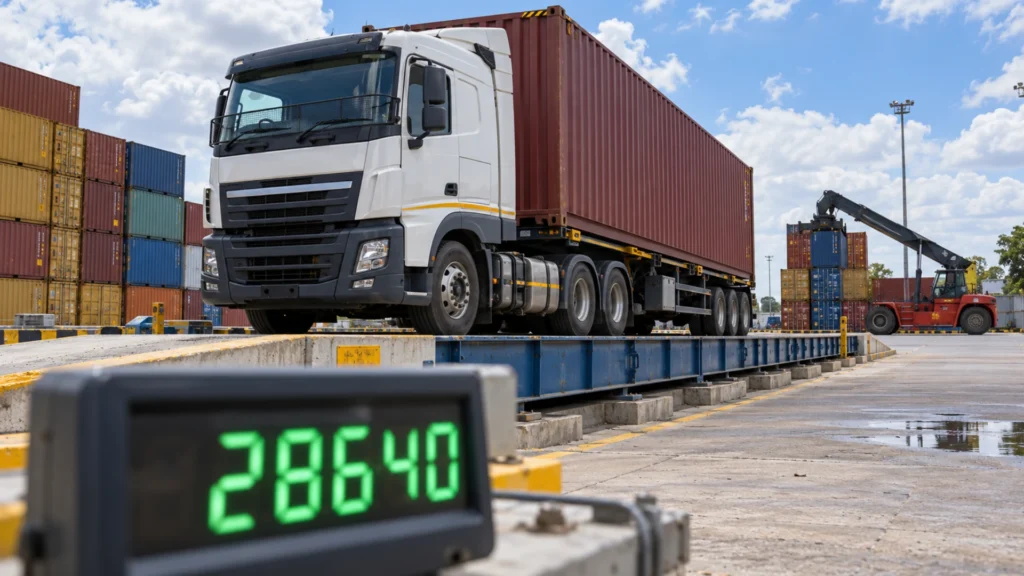
SOLAS VGM in South Africa is not optional paperwork. Every packed export container needs a verified gross mass before it can be loaded onto a ship, and a container without one can be refused at the terminal gate or left behind on the quay.
The rule has applied worldwide since 2016, but South African exporters also have to follow the requirements of the South African Maritime Safety Authority (SAMSA), meet shipping-line cut-offs and, under a newer SAMSA notice, make sure that the facility weighing their containers is properly authorised.
This guide explains what the verified gross mass is, how the two weighing methods work, how a weighbridge produces an accurate figure and what exporters should check before their containers reach the port.
Quick answer: SOLAS VGM is the verified gross mass of a packed container, which the shipper must provide before loading under SOLAS Chapter VI, Regulation 2. In South Africa, SAMSA enforces the rule. Shippers can weigh the packed container (Method 1) or weigh all contents and add the tare (Method 2, which needs SAMSA-recognised approval).
What Is SOLAS VGM?
The verified gross mass, or VGM, is the total gross mass of a packed container, including the cargo, packaging, dunnage, securing material and the container’s own tare mass. The International Maritime Organization’s guidelines define it as the gross mass obtained by one of the two approved methods, according to MSC.1/Circ.1475.
The requirement comes from an amendment to the International Convention for the Safety of Life at Sea (SOLAS), Chapter VI, Regulation 2. The IMO adopted the amendment through Resolution MSC.380(94), and it has applied since 1 July 2016. Accurate container weights help ship planners stow containers safely and reduce the risk of stack collapses, vessel instability and injuries.
Who Is Responsible for the VGM?
The shipper is responsible for the VGM. The IMO guidelines define the shipper as the party named on the bill of lading or sea waybill, and the VGM document must be signed by a person duly authorised by the shipper. The signature can be electronic or replaced by the authorised person’s name in capital letters.
SAMSA’s Marine Notice 18 of 2016 makes the shipper responsible for the VGM regardless of who actually packs the container. An exporter who uses a packing depot or a third-party warehouse therefore still owns the accuracy of the declared figure.
What Is the Difference Between Method 1 and Method 2?
SOLAS allows two methods for obtaining the VGM. Both are legal, but they suit different cargo and different operations.
| Aspect | Method 1 | Method 2 |
|---|---|---|
| What is weighed | The packed and sealed container | Every package and cargo item, plus packing and securing material |
| How the VGM is calculated | Taken directly from the weighing | Sum of all contents plus the container’s tare mass |
| Equipment | Calibrated and certified weighing equipment, such as a weighbridge | Calibrated scales for the individual items |
| Approval in South Africa | Weighing facility must meet SAMSA requirements | Shipper’s method must be approved through SAMSA’s certification process |
| Suitable for | All cargo, including bulk cargo | Not suitable for bulk cargo such as scrap or unbagged grain |
Method 1: Weighing the Packed Container
Under Method 1, the shipper, or a third party arranged by the shipper, weighs the packed and sealed container using calibrated and certified equipment. A weighbridge is the most common option for road-hauled containers because the container can be weighed on the truck.
The weighing equipment itself must meet South Africa’s legal metrology requirements. SAMSA’s 2016 notice required a verification certificate from a laboratory accredited by SANAS and designated by the National Regulator for Compulsory Specifications (NRCS), with periodic re-verification.
Method 2: Weighing the Contents
Under Method 2, the shipper weighs all packages and cargo items, including pallets, dunnage and securing material, and adds the tare mass of the container. The IMO guidelines say the tare mass marked on the container should be used, and Hapag-Lloyd notes that only the weight shown on the container door is legally binding. In South Africa, SAMSA certifies Method 2 shippers through appointed third parties, and PPECB is one of them.
How Is SOLAS VGM Enforced in South Africa?
SAMSA is the competent authority for SOLAS VGM in South Africa. Marine Notice 18 of 2016 set out the original local requirements, including weighing options, equipment certification and record keeping. Mis-declaring container weight is an offence, and the notice lists penalties including fines or imprisonment of up to 12 months.
Transnet Port Terminals requires the VGM in its NAVIS pre-advice before a container can be accepted. When the rules came into force, TPT said it would not weigh containers at the coastal terminals, according to Infrastructure News, so the VGM must be established before the container reaches the port.
The New Method 1 Authorisation Requirement
SAMSA has tightened the rules for Method 1. A marine notice published in December 2025 requires facilities that weigh packed containers under Method 1, including weighbridges, reach stackers, cranes and mobile systems, to be SAMSA-authorised weighing facilities, according to Freight News. The same report said Method 1 users would need a SAMSA certificate number in Transnet’s NAVIS system to stack their containers.
Sources report different implementation dates for this requirement. Freight News reported a 1 July 2026 deadline, while a SAMSA-appointed assessor’s FAQ refers to 1 November 2026. Exporters should confirm the current position with SAMSA and ask any weighing facility for its authorisation details before relying on its certificates.
How Does Weighbridge Weighing Work?
SAMSA’s Marine Notice 18 of 2016 describes two practical ways to weigh a container on a weighbridge:
- Gross minus tare of the vehicle: weigh the truck with the packed container, then weigh the truck alone. The difference is the mass of the packed container.
- Empty and packed comparison: weigh the truck with the empty container, then with the packed container. The difference, plus the container’s marked tare, gives the VGM.
The notice also warns about factors that can distort a weighbridge reading:
- Fuel levels changing between weighings
- The driver staying in or leaving the cab
- How the vehicle sits on the weighbridge deck
- Tyre pressure
When a truck carries two containers, each container must be weighed separately. Dividing the combined weight by two is not acceptable. Weighing facilities should also keep verification and calibration certificates, operator training records, maintenance records and weight tickets.
Why Axle Weighing Helps
A weighbridge that can weigh individual axles shows whether cargo inside the container is evenly distributed. An unevenly packed container can be legal at sea but overload a truck axle on the road, which creates a separate compliance and safety problem. Shipping & General’s 22 m multideck scale can perform axle weighing as well as VGM weighing.
What Happens If a Container Has No VGM?
SOLAS Regulation 2.6 states that a container without a verified gross mass shall not be loaded onto the ship. SOLAS does not set a fixed number of hours for submission; it requires the VGM in time for the ship’s stowage plan, and each shipping line sets its own cut-off.
Maersk asks for the VGM before the cargo gate cut-off and warns that at terminals with a “No VGM, No Gate-in” policy the container may be refused at the gate, with demurrage or detention possibly applying. ZIM publishes VGM cut-offs in its local schedules. Exporters who miss a cut-off can lose their vessel slot and face extra storage and rebooking costs.
Is There a Tolerance for VGM Differences?
SOLAS itself does not provide a margin of error. When a pre-declared VGM and a terminal’s own weighing differ, SAMSA’s 2016 notice says the terminal’s figure is used. A 2016 industry summary by the Standard Club reported a 2% enforcement tolerance applied by SAMSA on a case-by-case basis, but this is not a published SAMSA rule.
Shipping lines may also charge for discrepancies between the VGM and the weight in the shipping instructions. From 7 May 2026, Maersk’s weight discrepancy fee applies when the difference exceeds 3 000 kg, or 5 000 kg for tank containers. This is a commercial charge, not a legal tolerance.
A SOLAS VGM Checklist for South African Exporters
- Decide whether Method 1 or Method 2 suits the cargo.
- If using Method 2, confirm that the method is approved through SAMSA’s certification process.
- If using Method 1, confirm that the weighing facility holds current SAMSA authorisation and certified equipment.
- Use the tare mass marked on the container door.
- Name an authorised person to sign the VGM.
- Check the shipping line’s VGM cut-off for the specific vessel.
- Submit the VGM to the line and make sure it reaches the terminal pre-advice.
- Keep weight tickets and certificates on file.
Weighing is one step in a wider export chain. Shipping & General’s guide to reducing logistics costs in South Africa covers other ways exporters can avoid delays and rework.
Frequently Asked Questions About SOLAS VGM in South Africa
What does VGM stand for?
VGM stands for verified gross mass. It is the total mass of a packed container, including cargo, packaging, dunnage, securing material and the container’s tare mass.
Who enforces SOLAS VGM in South Africa?
The South African Maritime Safety Authority (SAMSA) is the competent authority. It sets local requirements through marine notices, including Marine Notice 18 of 2016 and a later notice on Method 1 weighing facilities.
Who is responsible for providing the VGM?
The shipper named on the bill of lading or sea waybill is responsible, regardless of who packs the container. A person authorised by the shipper must sign the VGM.
Can a weighbridge be used for VGM?
Yes. A weighbridge is a common Method 1 option. The facility must use calibrated and certified equipment and, under SAMSA’s newer notice, be an authorised weighing facility.
What happens if a container has no VGM?
Under SOLAS, a container without a verified gross mass shall not be loaded onto the ship. Terminals may refuse it at the gate, and the shipper can face extra storage and rebooking costs.
Which tare weight should be used for Method 2?
The tare mass marked on the container should be used. Shipping lines such as Hapag-Lloyd note that the weight shown on the container door is the legally binding figure.
Need a Container Weighed Before Export?
Shipping & General operates a 22 m multideck weighbridge at its Germiston facility, issues VGM certificates for exporters and can axle-weigh packed containers to check weight distribution.
Speak to the Shipping & General team about weighing export containers as part of your transport or depot booking.