


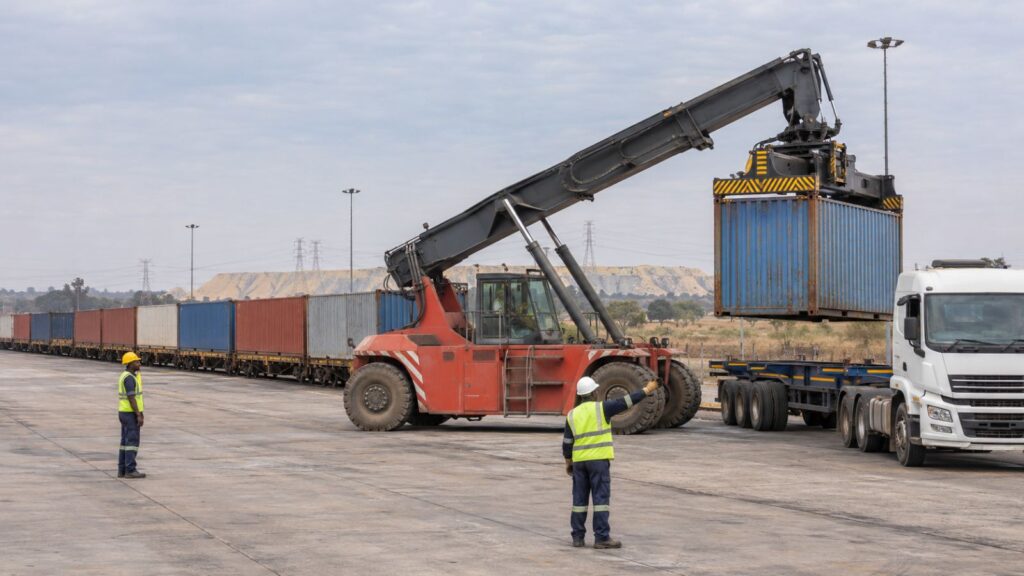
Most containers that land in Durban for Gauteng travel up the N3 on a truck. Road carries an estimated 87% of the corridor’s volume, and rail most of the rest (Freight News, 11 August 2026). In a normal month the road vs rail container transport decision is mostly about cost and timing. In December, it is about whether the box reaches you before your doors close.
Peak season stretches both modes at once. Holiday traffic builds on the N3 just as importers rush to clear containers before the shutdown, while rail capacity on the corridor has been interrupted more than once in 2026.
This guide compares road and rail between Durban and Gauteng, explains how each behaves in peak season, and sets out when to use one, the other, or both.
How Do Containers Move Between Durban and Gauteng?
By road, a truck collects the container at the Durban terminal and delivers it straight to your premises or to an inland depot. By rail, the container is loaded onto a train in Durban, offloaded at the City Deep terminal in Johannesburg, and then delivered by truck for the final leg.
That last step matters. Rail is never door to door on this corridor, so a rail move always includes a terminal lift at City Deep and a truck booking at the Gauteng end. Our City Deep container depot guide explains how the inland terminal works.
Road vs Rail Container Transport: How Do They Compare?
| Factor | Road (N3) | Rail (to City Deep) |
|---|---|---|
| Typical transit, port to Gauteng | 1 to 3 days | 3 to 5 days |
| Share of corridor volume | About 87% | Most of the remainder |
| Delivery | Door to door, or to a depot of your choice | To City Deep, then by truck |
| Free storage at Durban Pier 1 | 3 days after discharge | 5 days for City Deep rail-bound boxes |
| Main peak-season risk | N3 congestion and long terminal queues | Service interruptions and missed trains |
| Who controls the timing | You and your transporter | The rail schedule |
Transit times are from Freight News; free storage periods are from the Transnet Port Terminals tariff book for 2026/27.
How Does Peak Season Change the Choice?
Road in December
Heavy vehicles already make up more than 35% of traffic on the N3 toll route (N3 Toll Concession). In December they share the road with holiday traffic, and the busiest weekends fall exactly when importers want their last deliveries done.
The bottleneck is often at the port rather than on the highway. In September 2026, Positive Freight Solutions reported trucks waiting between 4 and 22 hours to collect containers in Durban (Freight News, 1 September 2026). Every hour in a queue is an hour the truck is not making its next trip, which is why road capacity tightens sharply before Christmas.
Rail in December
Rail moves volume without needing a truck for every box on the long haul, and the longer free storage period for rail-bound containers helps. The weakness is reliability. Business Unity South Africa and the South African Association of Freight Forwarders counted 781 containers railed out of Durban in the week of 17–23 August 2026, against 2,161 the week before, ahead of a corridor shutdown that ran into early September (BUSA/SAAFF cargo movement update).
A container that misses its train simply waits in Durban. In normal months that costs a few days. In mid-December it can cost the whole shutdown.
What Changes for Rail in 2027?
On 13 May 2026, Transnet announced 11 private train operating companies that had been allocated slots on its network (SAnews). The Operation Vulindlela progress report for the first quarter of 2026 says operations are expected from early 2027 (National Treasury), and one new entrant has said it plans container trains between Durban and City Deep (Railway Gazette, April 2026).
That could make rail a stronger option during 2027. Until a private service is running to a published schedule, treat it as a plan, not capacity you can book for this peak.
When Should You Choose Road, Rail or Both?
Choose road when:
- the container must arrive before a fixed date, such as your last receiving day before the shutdown;
- the cargo is high value and needs tracking or an escort;
- the cargo needs temperature control or continuous monitoring;
- the container has been stopped by customs and must move to a licensed depot.
Consider rail when:
- you are moving a steady volume of non-urgent containers;
- delivery dates have a few days of slack;
- a dependable rail service and a City Deep collection plan are both in place.
Use both when you can split cargo by urgency: rail for the base load, road for urgent boxes, and a road fallback for any container that misses its train.
How Does Shipping & General Move Containers on the Corridor?
Shipping & General runs container transport from Durban to Gauteng on the N3 for full and part loads, reefers, dangerous goods, abnormal loads and high-value cargo, with status updates pushed by email from our SAP system.
We also work the rail side of the corridor. Our extended-hours cartage from City Deep collects containers that arrive by rail and delivers them to your premises or to our customs-licensed depot in Germiston, about 5 km away, where they can be stored or unpacked if your site is closed.
Frequently Asked Questions About Road vs Rail Container Transport
How long does it take to move a container from Durban to Johannesburg?
Typically one to three days by road and three to five days by rail, measured from the port to Gauteng. Port queues, customs holds and holiday traffic can add to both.
Is rail cheaper than road for containers?
Sometimes, but compare the full door-to-door cost. A rail move adds a lift at City Deep and a final truck delivery, and a missed train can add storage costs that wipe out the saving.
What happens if my container misses its train?
It stays at the Durban terminal until the next available slot, unless you switch it to road. At Pier 1, rail-bound containers for City Deep get five free storage days, after which storage is charged.
Are private trains running between Durban and City Deep yet?
Not on a published schedule at the time of writing. Eleven private operators have been allocated network slots, and government expects operations to start from early 2027.
Can a rail container be delivered to a depot instead of my premises?
Yes. A transporter can collect it at City Deep and take it to an inland depot for storage or unpacking, which is useful when your site is closed.
Need Containers Moved From Durban Before the Holidays?
Tell us how many containers you have, when they land and when your site closes, and we will recommend the right mix of road transport, City Deep collection and depot storage.
We will confirm truck allocation before the peak weeks fill up.