






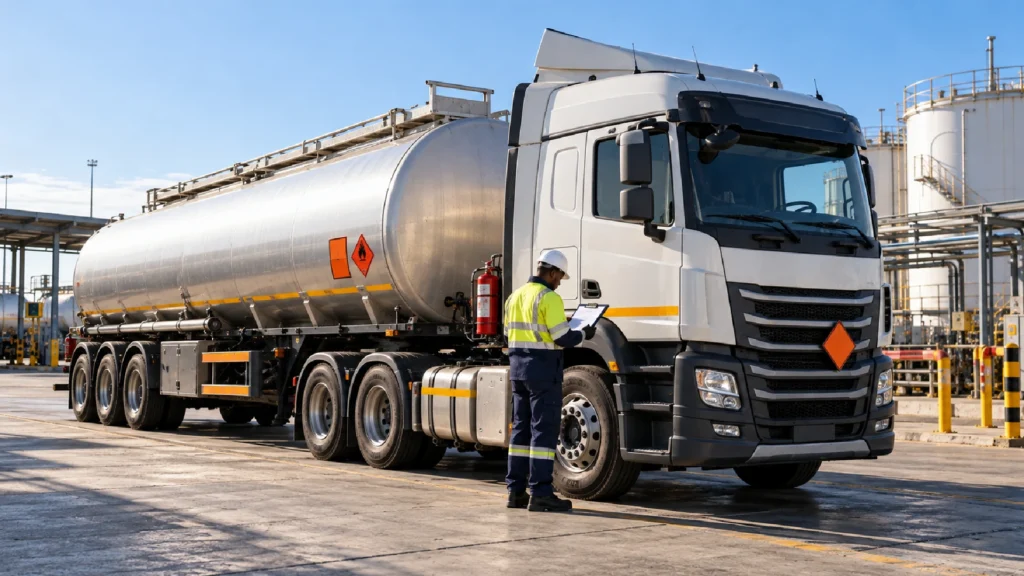
Dangerous goods transport in South Africa is governed by detailed rules that apply to everyone in the chain: the company that sends the goods, the transporter that carries them, the driver behind the wheel and the business that receives them. A missing document, a wrong placard or an untrained driver can stop a load at a roadblock, void insurance cover or turn a minor incident into a major one.
For shippers, the challenge is that many of the obligations sit with them rather than the transporter. Classification, packaging and documentation start at the point of dispatch, long before a truck arrives.
This guide explains the legal framework, the nine classes of dangerous goods, the duties of consignors, operators and drivers, and the vehicle markings and emergency information South African law requires.
Quick answer: Dangerous goods transport in South Africa is regulated by Chapter VIII of the National Road Traffic Regulations under the National Road Traffic Act 93 of 1996, which incorporates SANS standards for classification, packaging, operations and emergency information. Consignors must classify, package and declare the goods, while registered operators must use PrDP category D drivers and correctly marked vehicles.
What Law Governs Dangerous Goods Transport in South Africa?
The National Road Traffic Act 93 of 1996 prohibits the road transport of certain dangerous goods except as regulated. Chapter VIII of the National Road Traffic Regulations sets out those rules and incorporates a series of South African National Standards (SANS) into law, according to a Department of Transport presentation from October 2025.
| Standard | What it covers |
|---|---|
| SANS 10228 | Identification and classification of dangerous goods |
| SANS 10229-1 | Packaging of dangerous goods for road and rail transport |
| SANS 10231 | Operational requirements for transporting dangerous goods by road |
| SANS 10232-1 | Emergency information system for road transport, including vehicle marking |
| SANS 10232-3 | Emergency action guides |
| SANS 10232-4 | Transport Emergency Cards |
| SANS 10233 | Intermediate bulk containers |
| SANS 1518 | Design and construction of vehicles and tanks |
Standards are revised from time to time, so shippers should check which editions currently apply before relying on specific clause numbers.
What Are the Nine Classes of Dangerous Goods?
South Africa uses the United Nations classification system, which groups dangerous goods into nine classes, as summarised by the Chemical and Allied Industries’ Association (CAIA):
- Explosives
- Gases
- Flammable liquids
- Flammable solids, substances liable to spontaneous combustion and substances that react with water
- Oxidising substances and organic peroxides
- Toxic and infectious substances
- Radioactive material
- Corrosive substances
- Miscellaneous dangerous goods
The class determines the placards, packaging, segregation rules and emergency information that apply. Many products also carry a subsidiary risk, which adds further requirements.
What Must the Consignor Do?
The consignor, usually the shipper or manufacturer, carries the first set of legal duties. Under SANS 10231, the consignor must:
- Classify the goods correctly under SANS 10228
- Package the goods to the required standard
- Ensure that a qualified person supervises loading
- Give the driver a signed dangerous goods declaration
- Provide the emergency information for each product
The Dangerous Goods Declaration
The dangerous goods declaration, often called the DGD, is the core transport document. According to the CAIA information sheet, it must be headed “DANGEROUS GOODS DECLARATION” and include the proper shipping name and UN number, the quantity and type of packaging, the gross and net mass or volume, and the names and contact details of the consignor, operator and consignee.
Regulation 277 applies the incorporated standards to the operator, driver, consignor and consignee alike, so a shipper cannot pass full responsibility to the transporter. The consignee also has duties, including providing qualified people to supervise offloading.
What Must the Operator and Driver Do?
The operator, meaning the transport company, must register as a dangerous goods operator, agree the route with the driver, provide safety equipment and training and ensure that its drivers hold the correct professional driving permit.
Driver Requirements
A driver who carries dangerous goods above the exempt quantities needs a professional driving permit (PrDP) in category D for dangerous goods. According to the Department of Transport, the driver must be at least 25 years old and must present a training certificate from an approved training body that is not older than six months when applying. The permit is re-verified every second year, with a police clearance and an annual medical certificate.
Training bodies are approved by the Department of Transport under the regulations. SANS 10231 also requires ongoing driver training in the theory and practice of dangerous goods transport.
How Must a Dangerous Goods Vehicle Be Marked and Equipped?
Vehicles carrying dangerous goods above the exempt quantities must display warning markings so that other road users and emergency responders can identify the risk immediately. According to the Department of Transport and CAIA, requirements include:
- An orange warning diamond on the front of the vehicle, 250 mm, or 100 mm for vehicles with a gross vehicle mass under 3 500 kg
- Three placards per load compartment, one at the rear and one on each side
- A displayed dangerous goods operator card
- A municipal dangerous goods permit, issued after inspection under SANS 1157, regardless of the vehicle’s mass
- Fire extinguishers sized to the vehicle type
| Vehicle | Minimum fire extinguishers |
|---|---|
| Gross vehicle mass of 3 500 kg or less | 1 × 9 kg or 2 × 4.5 kg |
| Rigid vehicle over 3 500 kg | 2 × 9 kg |
| Truck-tractor | 1 × 9 kg |
| Trailer | 2 × 9 kg |
What Is a Transport Emergency Card?
A Transport Emergency Card, still widely called a TREMcard, tells the driver and emergency services what to do if something goes wrong. It is issued in line with SANS 10232-4. According to CAIA, one card is needed for each dangerous goods item, each card is valid for three years, and cards must be kept in a designated space in the cab, typically an orange container marked “DOCUMENT”.
A card typically includes the UN number, class and packing group, the emergency response guide number, required protective equipment, the driver’s first actions, fire-fighting and first-aid steps and emergency telephone numbers. The Department of Transport has proposed removing the old “Tremcard” definition from the regulations, reflecting the move to the Transport Emergency Card terminology.
Shipping & General supplies Transport Emergency Cards for UN-referenced products and requires its crews to read and understand the card for any product before loading it, as described on its value-added services page.
Can Different Dangerous Goods Travel Together?
Not always. Regulation 278 requires mixed loads to be compatible, and SANS 10231 contains a compatibility chart that shows which classes may travel on the same vehicle. Some combinations, such as certain oxidisers with flammable materials, can react dangerously if packaging fails. Shippers who send several hazardous products at once should check compatibility before booking a single vehicle.
What Are Exempt Quantities?
The regulations do not apply in full to goods carried below the exempt quantities. These thresholds depend on the specific commodity, its packing group and any subsidiary risk, and range from no exemption at all to 1 000 kg or litres, according to an industry guide. The exempt quantity tables sit in SANS 10231, so shippers should check the table for each product rather than assume a small load is exempt.
Who Enforces the Dangerous Goods Rules?
The Department of Transport’s dangerous goods inspectorate inspects consignors, consignees and operators and investigates incidents. Traffic officers can stop vehicles and demand documents, and the regulations treat documents and UN markings on packaging as evidence in a prosecution. Contravening the Act is a criminal offence.
The Department of Transport presented further proposed amendments in October 2025, including a new rule that an overloaded dangerous goods vehicle must move its excess load to a designated area at its own cost. These proposals still had to go through consultation and approval at the time of the presentation.
A Checklist for Shippers of Dangerous Goods
- Confirm the UN number, class and packing group for each product.
- Check whether the quantity exceeds the exempt quantity.
- Package and label the goods to the required standard.
- Prepare a complete, signed dangerous goods declaration.
- Provide a valid Transport Emergency Card for each product.
- Check compatibility if several products travel together.
- Confirm that the transporter is a registered dangerous goods operator with PrDP category D drivers.
- Make sure the consignee can offload safely with qualified staff.
How Does Shipping & General Handle Dangerous Goods Transport?
Shipping & General states that it complies with the National Road Traffic Act 93 of 1996 as it governs dangerous goods, that its drivers hold the required certifications and licence endorsements, and that it is permitted and equipped to handle all classes of hazardous commodities except Class 1 explosives. The company also holds Ekurhuleni municipality accreditation to store various hazard classes at its Germiston facility, which lets containerised hazardous cargo move from port to depot to customer with one provider.
Hazardous imports often arrive in containers and may be stopped for customs examination. Shipping & General’s guide to customs-licensed container depots explains how depot storage fits into that process.
Frequently Asked Questions About Dangerous Goods Transport in South Africa
Which law regulates dangerous goods transport in South Africa?
Chapter VIII of the National Road Traffic Regulations under the National Road Traffic Act 93 of 1996 regulates dangerous goods transport by road and incorporates SANS standards into law.
What licence does a driver need to carry dangerous goods?
A driver needs a professional driving permit in category D for dangerous goods. The Department of Transport requires the driver to be at least 25 and to hold a recent certificate from an approved training body.
What is a dangerous goods declaration?
A dangerous goods declaration is the transport document the consignor gives the driver. It lists the proper shipping name, UN number, packaging, quantities and the contact details of the consignor, operator and consignee.
What is a TREMcard?
A TREMcard is the common name for a Transport Emergency Card issued under SANS 10232-4. It gives the driver and emergency responders product-specific instructions for incidents and must be kept in the vehicle cab.
Do small quantities of dangerous goods need to comply?
Goods below the exempt quantities do not need to meet all the requirements. The thresholds depend on the product, packing group and subsidiary risk, so shippers should check the exempt quantity table for each product.
Can Shipping & General transport Class 1 explosives?
No. Shipping & General is permitted and equipped to transport all classes of hazardous commodities except Class 1 explosives.
Moving Hazardous Cargo by Road?
Shipping & General transports hazardous commodities in all classes except Class 1 explosives, supplies Transport Emergency Cards and stores various hazard classes at its Ekurhuleni-accredited facility in Germiston.
Speak to the Shipping & General team about compliant road transport, containerised dangerous goods or hazchem storage for your next consignment.