


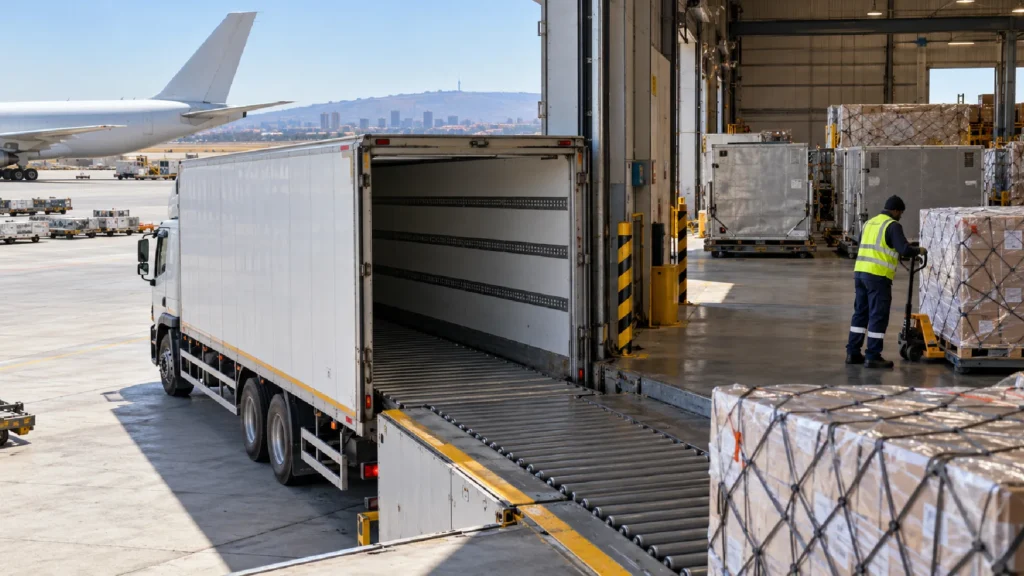
Airfreight cartage is the road leg that moves air cargo between O.R. Tambo International Airport and the businesses that send or receive it. It covers collecting import cargo once it is released, moving uncleared consolidations to licensed depots and delivering export cargo to the airlines before their cut-off.
Air cargo is often urgent, often valuable and sometimes hazardous. A shipment that crossed continents overnight can still lose a day on the last few kilometres if the truck arrives before customs release, the wrong vehicle is sent for a ULD, or the receiving dock is closed.
This guide explains how air cargo moves through O.R. Tambo, what the customs terms mean, who may carry uncleared goods, what equipment the job needs and how to avoid the most common delays.
Quick answer: Airfreight cartage is the road transport of air cargo between the airport and the importer, exporter or a licensed depot. At O.R. Tambo it covers collecting released cargo from airline cargo terminals, moving uncleared consolidations to SARS-approved degrouping depots and delivering export cargo to the airlines on time.
What Is Airfreight Cartage?
Cartage is the short-distance road transport that connects a port, terminal or airport with its surrounding businesses. With air cargo, the road leg has three common forms:
- Import collection: picking up cargo released by customs and delivering it to the consignee.
- Bonded transfer: moving cargo that has not been cleared yet, for example from a transit shed to a degrouping depot.
- Export delivery: taking cargo from the shipper to the airline or its handling agent before the flight cut-off.
Speed matters more here than on most road jobs, because the customer has already paid for the fastest mode of transport. The cartage leg should not undo that advantage.
Why Is O.R. Tambo Central to Air Cargo?
Airports Company South Africa describes O.R. Tambo as “the biggest and busiest airport in Africa” and the flagship of its network of nine airports. According to ACSA, the airport has a cargo facilitation capacity of 650,000 tonnes a year.
For Gauteng importers, it puts international air cargo a short drive from their premises. The airport’s location on the East Rand also puts it close to the logistics hubs in Kempton Park, Isando, Germiston and City Deep.
How Does Air Cargo Move Through O.R. Tambo?
Import Cargo
Once an aircraft is offloaded, import cargo passes through a sequence of customs-controlled places before it can be delivered.
| Stage | What it is | What happens there |
|---|---|---|
| Transit shed | Secure premises approved by SARS, normally within the airport perimeter | Cargo is held until customs releases it or it is delivered to a degrouping depot |
| Degrouping depot | A depot approved by SARS for air cargo | Consolidated cargo is stored, unpacked and examined before clearance |
| Customs release | Clearance of the goods by SARS | The cargo can be collected and delivered to the consignee |
SARS’s temporary storage page explains that transit sheds are “secure premises approved by the Commissioner”, normally situated within the perimeter of the harbour or airport. Imported cargo stays there until it is cleared and released by customs or delivered to a degrouping depot.
Degrouping depots are approved under section 6(1)(hC) of the Customs and Excise Act, at places listed in rule 200.09. According to the SARS depots page, “air cargo may be removed from a transit shed before due entry” for storage, detention and unpacking at these depots. That is how a freight forwarder’s consolidation can be broken down into individual shipments before each one is cleared.
Moving Uncleared Cargo
Cargo that has not been cleared is still under customs control, so moving it by road is a bonded movement. SARS states that carriers who convey bonded cargo by road must be licensed as removers of goods in bond, and must lodge security covering the duties and taxes on the goods they carry.
For importers, this means the transporter for a bonded transfer, such as transit shed to degrouping depot, should hold that licence. Our guide to the remover of goods in bond explains how it works and why it matters.
Export Cargo
Exports run the other way and against the clock. The shipper packs and labels the cargo for air, the freight forwarder books space and prepares the documents, and the cargo has to reach the airline or its handling agent at the cargo terminal before the acceptance cut-off for the booked flight. Cargo that misses the cut-off has to wait for the next available flight, which can mean a day or more on routes with limited capacity.
The road leg for exports is where small problems surface: a pallet that is taller than the booking, a missing label, or a consignment that is not ready when the truck arrives. Agreeing a collection time with a buffer before the cut-off, and confirming dimensions in advance, prevents most of them.
What Equipment Does the Job Need?
Air cargo does not always arrive as loose cartons. Some of it travels on ULDs. IATA defines a unit load device as “either an aircraft pallet and pallet net combination, or an aircraft container”.
Moving a ULD by road needs a vehicle with a suitable deck, typically a closed-body truck with a roller floor so the unit can be rolled on and off at the dock. Loose and palletised air cargo, by contrast, often needs a smaller closed vehicle and, where the consignee has no forklift, a tail-lift.
A closed body also matters for security. Air cargo can be high in value, and an enclosed, tracked vehicle reduces the exposure on the last leg.
What About Dangerous Goods by Air?
Some air cargo is classified as dangerous goods, and the rules for the flight and the road leg are different. The South African Civil Aviation Authority states that their safe transport by air is governed by the SACAA regulations, SACAR Part 92, with items carried in accordance with the ICAO Technical Instructions. Freight forwarders, consolidators and couriers are among those required to have dangerous goods training programmes.
Once the cargo leaves the airport by road, the road rules apply instead. Our dangerous goods transport guide covers what the National Road Traffic Regulations require of the transporter and driver.
How Can You Avoid Delays at the Airport?
- Share the air waybill number and flight details as soon as they are known.
- Confirm the customs status: released, or moving in bond to a degrouping depot.
- Give accurate piece counts, weights and dimensions, and say if the cargo is on a ULD.
- Flag dangerous goods and high-value cargo before the vehicle is dispatched.
- Confirm delivery addresses, receiving hours and whether a forklift is available on site.
- For exports, confirm the airline’s acceptance cut-off and that the cargo is packed and labelled for air.
How Does Shipping & General Handle Airfreight Cartage?
Shipping & General’s transportation page describes its experience in the air cargo environment and the drawing processes at O.R. Tambo. It deploys vehicles to collect time-sensitive airfreight shipments, and its equipment is often on standby within airport precincts while it waits for a flight to arrive and for clearances.
Its delivery crews check that shipments are properly quantified before taking custody or handing over to the airline. It runs closed-body pantech vehicles with purpose-designed roller decks for airfreight containers consigned to licensed degroup facilities. Shipping & General is also a licensed remover of goods in bond with a road bond guarantee lodged with customs, as stated on its depot and warehousing page.
For deliveries to premises without a forklift, its value-added services include tail-lift trucks with an extra crew member and a pallet jack. High-value cargo is assigned to specially trained delivery crews.
Frequently Asked Questions About Airfreight Cartage
What is airfreight cartage?
It is the road transport of air cargo between the airport and the importer, exporter or a licensed depot, including collections, bonded transfers and export deliveries to airlines.
What is a transit shed at the airport?
A transit shed is a secure premises approved by SARS, normally within the airport perimeter, where imported cargo is held until customs releases it or it is delivered to a degrouping depot.
What is a degrouping depot?
It is a SARS-approved depot where air cargo can be taken from a transit shed before due entry for storage, detention and unpacking, so consolidations can be broken down and cleared.
Can air cargo leave the airport before customs clearance?
Yes, but only under customs control, such as a transfer to a degrouping depot. Carriers moving bonded cargo by road must be licensed by SARS as removers of goods in bond.
What is a ULD in air cargo?
A unit load device, or ULD, is either an aircraft pallet and pallet net combination or an aircraft container, according to IATA.
Does Shipping & General collect airfreight from O.R. Tambo?
Yes. Shipping & General collects time-sensitive airfreight from O.R. Tambo and runs roller-deck pantech vehicles for airfreight containers going to licensed degroup facilities.
Need Air Cargo Collected From O.R. Tambo?
Shipping & General collects time-sensitive airfreight from O.R. Tambo with closed-body and roller-deck vehicles, and is a licensed remover of goods in bond.
Share your air waybill and delivery details, and our team will quote for collection and delivery.