


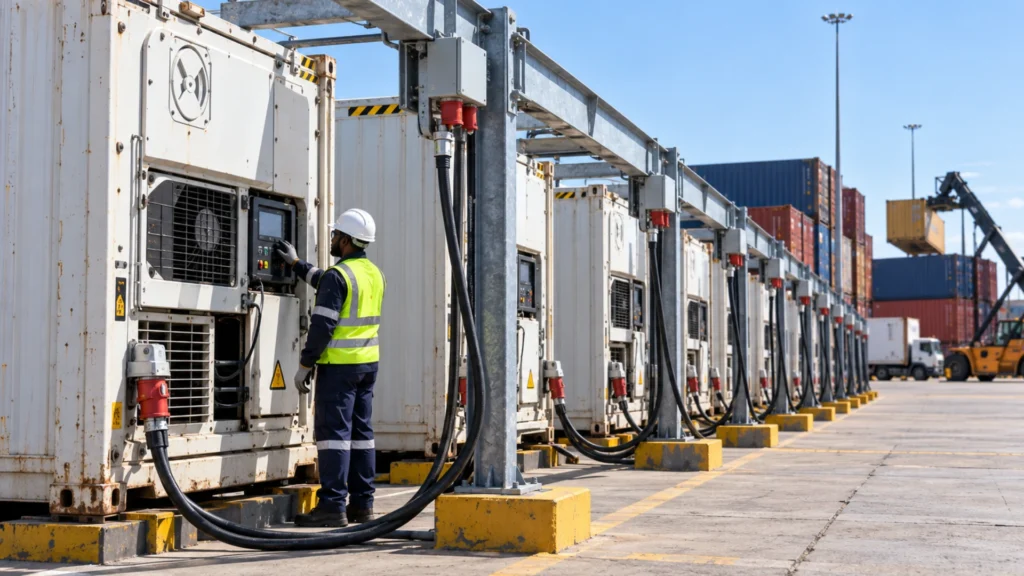
Reefer plug points are the power connections that keep a refrigerated container running when it is not on a ship or behind a truck fitted with a generator. For Gauteng importers and exporters, they are what make it possible to hold a reefer at an inland depot over a weekend, a public holiday or a delivery delay without breaking the cold chain.
A reefer container carries its own refrigeration unit, but not its own power. At every stop between the ship and the final cold store, something has to supply electricity: a terminal stack, a road genset or a depot socket. Each handover is a point where cargo can be left without cooling.
This guide explains what plug points do, what South African export rules say about time without cooling, how ports manage reefer power, how temperatures are monitored and what to ask before you stage a reefer inland.
Quick answer: Reefer plug points are electrical sockets that power a refrigerated container’s own cooling unit while it is parked at a port, terminal or depot. Inland, they let a reefer be staged safely over weekends, public holidays or delays, with temperatures monitored, until it moves on under genset power to its destination.
What Are Reefer Plug Points?
A plug point is a dedicated power outlet, usually in a rack or row beside a reefer stack, that a container’s power cable connects to. Once connected, the container’s refrigeration unit holds the set temperature, and staff can check that it is running and alarm-free.
At South Africa’s ports, connecting and monitoring reefers is part of terminal handling. Transnet Port Terminals’ tariff book, effective from 1 April 2026, lists “making reefer connections and monitoring” within its terminal handling service. Inland, the same job falls to the depot that receives the container.
Why Do Reefers Need Plug Points Inland?
A typical import reefer bound for Gauteng moves from the vessel to a port stack, onto a truck with a genset, and then to the consignee. That chain works when everything lines up. Reasons it may not include:
- The consignee’s receiving dock is closed over a weekend or public holiday.
- Customs has not released the cargo, or documents are delayed.
- The cold store has no space for a day or two.
- An export reefer is ready before its vessel stack opens at the port.
In each case the container needs somewhere to wait, under power, with someone watching it. A depot with powered reefer stacks fills that gap, so the truck and genset can be released and the cargo does not sit unpowered.
Handovers need particular care. When a reefer arrives at a depot, the receiving team should confirm that the unit is running, compare the displayed set point with the booking or carrying instructions, record the actual readings and check the power cable and plug before connecting. The same readings should be taken again when the container leaves, so there is a clear record of what happened while it was in the depot’s care. If the set point on the unit does not match the instructions, the depot should stop and ask rather than guess.
How Long Can a Reefer Container Be Unplugged?
There is no single safe time in South African law. How long cargo can go without cooling depends on the product, its temperature when loaded and the conditions around it. Chilled fruit that is still respiring, frozen meat and temperature-controlled pharmaceuticals react very differently to the same few hours without power, and a hot Highveld afternoon is not the same as a cold winter night.
For perishable exports, the regulations under the Perishable Products Export Control Act, published as Board Notice 709 of 2024 in Government Gazette 51903 on 17 January 2025, use the term TTT: “the total length of time for which a perishable product may be left without cooling”. Some examples from those regulations:
| Product | Rule on time without cooling | Regulation |
|---|---|---|
| Citrus fruit | A total TTT of 16 hours, after which cooling must be applied | 44 |
| Deep-frozen products | A standard maximum cumulative TTT of 12 hours | 47(7) |
| Avocados loaded inland | Containers conveyed to a port must be fitted with gensets if the TTT is to be exceeded | 39(6) |
These are export rules for specific products. For imports and other cargo, follow the shipper’s and shipping line’s carrying instructions. The safe rule of thumb is simple: treat every unpowered minute as time the cargo cannot get back.
What Do the Port Rules Say About Plugging In?
The same export regulations place clear duties on the port terminal operator for refrigerated containers. Regulation 21 requires the operator to connect the container to a power supply and confirm it is working, to inspect the stock of refrigerated containers every four hours, and to make sure containers are re-connected to power during any interruption in vessel loading.
Capacity at the ports is large but not unlimited. In a Transnet Port Terminals statement of 4 April 2024, Durban Container Terminals Pier 1 confirmed 1,440 plug points with back-up power, Pier 2 had 2,424 plug points and the Durban Multipurpose Terminal had 277.
Transnet’s tariff book defines Durban’s reefer peak as 1 May to 31 October, the period “where demand for available reefer plug points is the highest”. It also lists a reefer power supply charge for export containers that arrive in the terminal before the stack opens: R553 per 20ft and R820 per 40ft, per day or part of a day, excluding VAT. Staging an export reefer inland until its stack opens is one way to plan around that.
How Are Reefer Temperatures Monitored?
Plugging in is only half the job. Someone has to confirm the unit is running at the right set point and react quickly to alarms.
The export regulations set a clear standard for refrigerated road transport: the vehicle must be fitted with a permanently mounted temperature recorder, and the recorder must log temperature, date and time at least once every hour. Delivery and return air temperatures (DAT and RAT) must be recorded continuously or at least hourly.
At a depot, good practice is to record each container’s set point and actual readings at regular checks, keep that log with the container’s file and escalate any alarm to the client and the shipping line straight away.
What Should You Ask a Depot Before Staging a Reefer?
- How many plug points does the depot have, and are they available over weekends and public holidays?
- How often are plugged-in containers checked, and can you see the temperature log?
- Who is called when a unit alarms, and how quickly?
- Can the depot inspect, wash or repair a reefer unit on site if needed?
- Can the same operator haul the container with a genset, so there is no gap between road and depot?
How Does Shipping & General Keep Reefers Powered?
According to its depot and warehousing page, Shipping & General’s depot facilities are equipped with 20 reefer plug points, giving it capacity to stage reefer containers over weekends, public holidays or as clients require. Its road haulage and depot reefer storage are run to stay in sync, aiming for an unbroken last-mile service.
On the road, its transportation page states that a fleet of 10 underslung reefer gensets keeps set temperatures stable from loading until the container is offloaded. At the depot, Shipping & General operates a PPECB-certified reefer workshop, washing and pre-trip inspection facility run by an IICL-certified team. Read our guide to reefer container pre-trip inspections for what a PTI checks.
PPECB itself is a national public entity mandated under the Perishable Products Export Control Act to perform cold chain services, which is why its certification matters to exporters of perishable products.
Frequently Asked Questions About Reefer Plug Points
What is a reefer plug point?
It is a power outlet that a refrigerated container connects to while parked at a port, terminal or depot, so its refrigeration unit can keep running and hold the set temperature.
How long can a reefer container be unplugged?
There is no general safe time. South Africa’s perishable export regulations set product-specific limits, such as a total of 16 hours without cooling for citrus and a 12-hour cumulative maximum for deep-frozen products.
Do reefer containers need a genset on the road?
A genset is what powers the container’s refrigeration unit during road haulage. For example, the export regulations require gensets on inland-loaded avocado containers if the time without cooling would be exceeded.
Does Transnet charge for reefer power at the port?
Yes. Transnet’s tariff book lists a reefer power supply charge for export containers that arrive before the stack opens, per day or part of a day.
How often should plugged-in reefers be checked?
The export regulations require port terminal operators to inspect their stock of refrigerated containers every four hours. A depot should be able to tell you its own checking routine.
Can Shipping & General stage reefer containers in Gauteng?
Yes. Shipping & General’s depot has 20 plug points for staging reefer containers over weekends, public holidays or as clients require.
Need to Stage a Reefer Container in Gauteng?
Shipping & General’s depot stages reefer containers under power over weekends and public holidays, with genset haulage to and from the depot.
Tell us the container, set temperature and dates, and we will confirm availability and send a quote.