


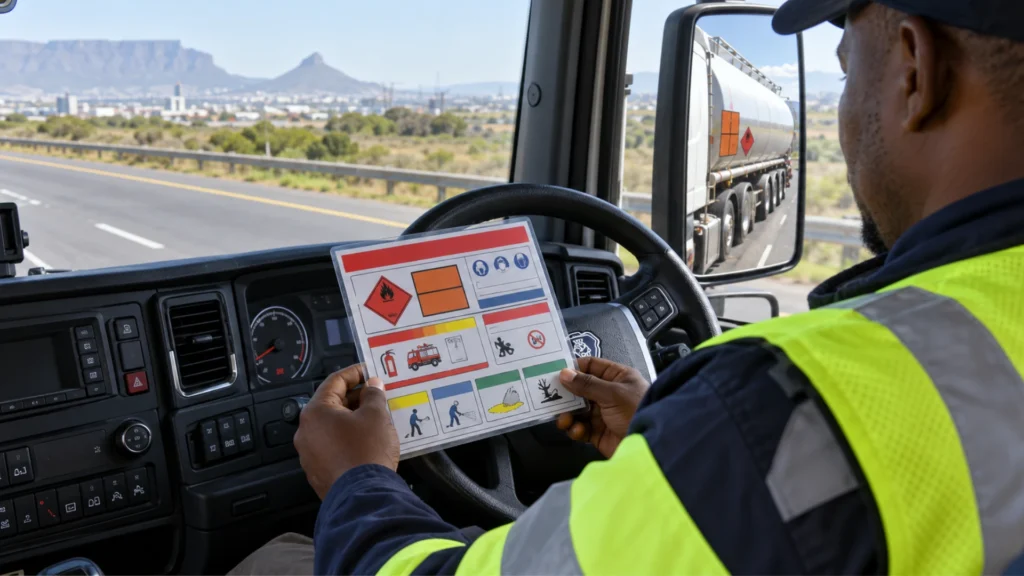
A tremcard is the transport emergency card that must travel in the cab of every vehicle carrying dangerous goods by road in South Africa. It is a short, product-specific instruction sheet that tells the driver, and anyone who arrives at an incident, what the hazards are and what to do in an emergency.
The card is easy to treat as paperwork until a vehicle is stopped at a roadside inspection or something leaks on the N3. At that point, the right card for each product in the load is one of the first things a traffic officer, fire crew or the driver will reach for.
This guide explains what the card is, where it comes from in law, how it differs from the other documents and markings on a dangerous goods vehicle, who is responsible for it and how shippers can check they are covered before a load leaves.
Quick answer: A tremcard, now formally called a transport emergency card, is a standardised card that lists the hazards and emergency information for a dangerous goods item carried by road. Under the National Road Traffic Regulations, a dangerous goods vehicle must carry one for each dangerous goods item in the load, kept in an orange “DOCUMENT” holder in the cab.
What Is a Tremcard?
The term “tremcard” is the older, industry name for what South African regulations now call a transport emergency card. On the road you will hear both, along with “TREC” and “TEC card”. They all refer to the same document.
The 2008 Fifteenth Amendment to the National Road Traffic Regulations replaced the old “tremcard” definition. It defines a transport emergency card as a card generated either from the European chemical manufacturers’ federation (CEFIC) system or in accordance with SANS 10232-4, “listing the hazards and emergency information for a material being transported”, for use by the driver during an incident or by the emergency services.
In practice, that makes the card a quick reference rather than a full technical document. It is written for a driver who may be shaken, in poor light, at the side of a highway, and for responders who need the essentials in seconds.
What Does the Law Say About Transport Emergency Cards?
Road transport of dangerous goods is regulated under the National Road Traffic Act 93 of 1996 and Chapter VIII of the National Road Traffic Regulations. The Department of Transport’s October 2025 presentation on dangerous goods by road explains that section 76 of the Act, read with regulation 273A, incorporates the dangerous goods standards into law.
One of those standards is SANS 10232-4. Its current title, listed in Government Gazette 41996 of 26 October 2018, is “Transport of dangerous goods – Emergency information systems – Part 4: Transport emergency card”. The standard sets out how a card is prepared, so that every card follows a standardised format and uses standardised phrases.
The same Department of Transport presentation summarises the core rules:
- Any vehicle used to transport dangerous goods must carry a transport emergency card for each dangerous goods item in the load.
- The card is used by the driver or the emergency services in case of an incident.
- The card must comply with SANS 10232-4 and is valid for three years.
- It must be kept in the designated space in the cab: an orange container marked “DOCUMENT” in black, in a conspicuous place.
What Information Does the Card Give?
The card exists to make the driver aware of the dangers associated with the load and to act as a concise reference in an emergency. Because it is prepared in a standardised format, a driver or firefighter who has seen one card can find the same information in the same place on the next.
Two points matter most for shippers. First, the card is product-specific: one card per dangerous goods item, not one card per truck. A mixed load of three different products needs three cards. Second, the card has to match what is actually on the vehicle. A card for a similar product, or a card from an old supplier formulation, defeats the purpose.
Shipping & General’s value-added services page puts it plainly: as the operator and carrier, it has a legal obligation to ensure that cards are appropriate to the load, and its road crews must read and understand the card for any product before loading it.
How Is the Card Different From Other Dangerous Goods Documents?
A dangerous goods vehicle carries several documents and markings that work together. Knowing which is which makes roadside checks quicker.
| Item | What it does | Where it is |
|---|---|---|
| Transport emergency card | Hazards and emergency information for one dangerous goods item | Orange “DOCUMENT” holder in the cab |
| Dangerous goods declaration | Proper shipping name, UN number, quantity and type of packaging, mass, and consignor, operator and consignee details | Orange “DOCUMENT” holder in the cab |
| Placards and markings | Identify the vehicle as carrying dangerous goods, as prescribed in SANS 10232-1 | On the outside of the vehicle |
| PrDP category D | Authorises the driver to drive a dangerous goods vehicle | Carried by the driver |
The Department of Transport lists the documents a driver must hold under regulation 281. These include transport emergency cards and dangerous goods declarations, a valid driving licence, a PrDP in category D and a dangerous goods permit issued under SANS 1157. A complete, correct set in the cab is the simplest way to keep an inspection short.
Who Is Responsible for the Card?
Regulation 277 sets out the “duties of operator, driver, consignor and consignee”, and the Department of Transport presentation notes that these parties share duties under Chapter VIII. Responsibility does not sit with one party alone.
- The consignor knows the product best and is the natural source of accurate product information for the card and the declaration.
- The operator must make sure every prescribed requirement is met before the vehicle moves, including that the cards on board match the load.
- The driver must carry the cards in the designated holder and know how to use them.
- The consignee receives the goods and has its own duties under the same regulation.
Drivers are part of the picture too. According to the government’s PrDP service page, a driver must be 25 or older to hold a PrDP for a dangerous goods vehicle, and category D applicants must be certified by an approved training body.
What Should Shippers Check Before a Load Leaves?
A short check at dispatch prevents most problems. Before handing over a dangerous goods consignment, confirm that:
- There is a transport emergency card for every dangerous goods item in the consignment.
- Each card matches the product on the declaration, not a similar product.
- Each card is within its three-year validity.
- The dangerous goods declaration is complete and travels with the cards.
- The transporter’s vehicle is placarded for the load and the driver holds a PrDP in category D.
If any item is missing, it is far cheaper and quicker to fix it at the loading bay than at a roadside inspection, when the truck, the driver and the consignee are all waiting.
How Does Shipping & General Handle Tremcards?
Shipping & General supplies transport emergency cards for every imaginable UN-referenced product, according to its value-added services page, and provides them to clients for whom it transports hazardous products. Its crews undergo training in this field and regular refresher courses to stay current with best practice and regulatory changes.
On the transport side, Shipping & General states on its transportation page that it is fully compliant with the National Road Traffic Act, that its drivers hold the relevant certifications and licence endorsements, and that it is permitted and equipped to handle all classes of hazardous commodities except Class 1 explosives. Its Hazchem-approved facility also holds Ekurhuleni municipality accreditation for the storage of various hazard classes.
For the wider compliance picture, including classification, declarations, placarding and exempt quantities, read our dangerous goods transport guide.
Frequently Asked Questions About Tremcards
What does tremcard mean?
It is the older name for a transport emergency card. It is a standardised card that lists the hazards and emergency information for a dangerous goods item, for use by the driver and emergency services during an incident.
Does every dangerous goods item need its own card?
Yes. The Department of Transport states that a dangerous goods vehicle must carry a transport emergency card for each dangerous goods item in the load, so a mixed load needs one card per product.
How long is a transport emergency card valid?
The Department of Transport’s guidance states that a transport emergency card is valid for three years. Cards should also be replaced sooner if the product or its hazards change.
Where must the card be kept in the vehicle?
It must be kept in the designated space in the cab, an orange container marked “DOCUMENT” in black, in a conspicuous place, together with the dangerous goods declaration.
Are placards and transport emergency cards the same thing?
No. Placards are markings on the outside of the vehicle, prescribed in SANS 10232-1, that identify it as carrying dangerous goods. The transport emergency card is a document in the cab with emergency information for each product.
Can Shipping & General supply transport emergency cards?
Yes. Shipping & General supplies transport emergency cards for UN-referenced products to clients for whom it transports hazardous goods.
Need Transport Emergency Cards for Your Load?
Shipping & General supplies transport emergency cards for UN-referenced products and transports all classes of hazardous goods except Class 1 explosives.
Tell us what you are moving and where, and our team will come back to you with a quote.