






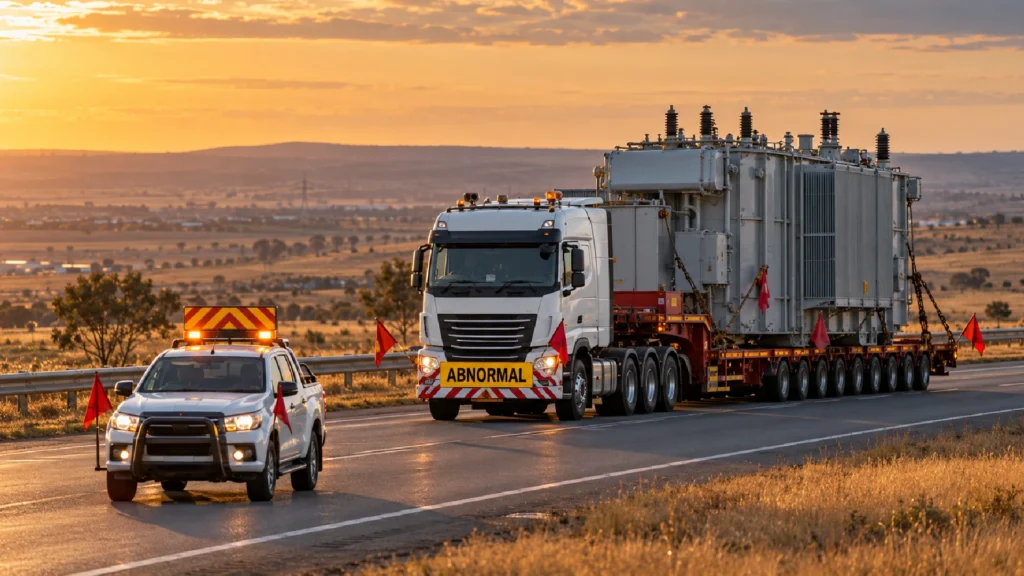
Abnormal load transport in South Africa involves far more than a big truck. Transformers, mining equipment, industrial plant, boats and structural steel often exceed the legal size or mass limits for ordinary road vehicles, and moving them legally requires a permit, a planned route, the right equipment and, in many cases, escort vehicles.
Mistakes in abnormal load transport are expensive. A load that arrives at a low bridge, a tight intersection or a provincial boundary without the right permit can sit on the roadside for days, and an unsafe move puts road users and the cargo at risk.
This guide explains what makes a load abnormal, how the permit system works, when escorts are required, which travel restrictions apply and how to plan an oversized or overweight move from site assessment to delivery.
Quick answer: A load is abnormal in South Africa when an indivisible object cannot be transported without exceeding the dimension or mass limits in the National Road Traffic Regulations. It needs an exemption permit under section 81 of the National Road Traffic Act, issued by provincial permit offices according to the TRH 11 guidelines, which also set escort, signage and travel-time conditions.
What Makes a Load Abnormal in South Africa?
The Committee of Transport Officials’ TRH 11 guidelines define an abnormal load as an indivisible, for practical purposes, object that cannot be transported on a vehicle without exceeding the dimension or mass limitations in the National Road Traffic Regulations, 2000.
The main legal dimension limits summarised in TRH 11 are:
| Dimension | Legal limit |
|---|---|
| Width | 2.6 m for goods vehicles of 12 000 kg or more; 2.5 m for other vehicles |
| Height, including the load | 4.3 m |
| Length, single vehicle | 12.5 m |
| Length, articulated vehicle | 18.5 m |
| Length, other combinations | 22.0 m |
| Load projection | No more than 300 mm at the front and 1.8 m at the rear |
The regulations also set mass limits for individual axles, axle units and vehicle combinations. A load that exceeds any dimension or mass limit becomes abnormal and needs a permit, even if it is only slightly over.
What Is an Indivisible Load?
The permit system only applies to loads that cannot reasonably be split. The TRH 11 administrative guidelines define an indivisible load as one that cannot, without disproportionate effort, expense or risk of damage, be divided into two or more loads for transport on public roads. A permit will only be considered where there is no possibility of transporting the load legally.
How Do Abnormal Load Permits Work?
Section 81 of the National Road Traffic Act allows the provincial MEC, after the applicant pays the fees and subject to conditions, to authorise the conveyance of a load that does not comply with the Act. In practice, provincial abnormal load permit offices process these applications using the TRH 11 administrative guidelines.
What an Application Needs
According to the administrative guidelines, an application must include:
- The registration numbers of the vehicles in the combination
- A description of the load and its dimensions
- The mass of the load and the resulting axle loads
- A detailed route with street names and route numbers
Very heavy moves need more. The guidelines require an engineer’s route clearance for loads above 125 000 kg, because bridges and culverts along the route must be assessed for the load.
Permits Are Route-Specific and Time-Bound
A permit covers a specific route and period. Under the 2010 administrative guidelines, a single-trip permit is valid for between two days for short trips and six days for long ones, extendable where a traffic-officer escort is involved, while period permits can run from one week to twelve months. Permit offices may have updated these rules since, so operators should confirm current conditions with the issuing province.
Some provinces now accept applications online. The Western Cape, for example, processes abnormal load applications through its online permit system.
When Does an Abnormal Load Need an Escort?
TRH 11 groups abnormal loads into dimensional classes and links each class to escort requirements that depend on the road category. Wider roads with higher standards allow larger loads with fewer escorts; narrow roads require more.
| TRH 11 class | Maximum width | Maximum length |
|---|---|---|
| D1 | 2.75 m | 27 m |
| D2 | 3.00 m | 30 m |
| D3 | 3.25 m | 34 m |
| D4 | 3.75 m | 40 m |
| D5 | 4.75 m | 54 m |
| D6 | Larger than D5 | Larger than D5 |
Examples from TRH 11 show how the rules scale. A D5 load needs one of the operator’s own escort vehicles on the widest road category but two traffic-officer escorts on narrower roads, while a D6 load always needs two traffic-officer escort vehicles. Loads higher than 4.7 m need an escort travelling ahead, and loads projecting more than 1.8 m at the rear need an escort behind.
Escorts must be arranged in advance. The administrative guidelines require the police officer named on the permit to be notified at least 72 hours before the trip, and the local chief traffic officer at least two hours before the vehicle arrives.
When Can Abnormal Loads Travel?
Travel restrictions protect other road users during busy or dangerous periods. Under the TRH 11 administrative guidelines:
- Abnormal loads may not travel on Saturdays, Sundays or public holidays unless the permit allows it.
- Night travel is generally not allowed, although permit offices can approve it in specific cases such as metropolitan areas.
- Provinces set annual embargo days around school holidays and long weekends.
- Metropolitan areas may prohibit travel during morning and afternoon peak hours.
- Permit conditions can restrict travel in wet or windy weather.
Embargo dates change each year. The Western Cape, for example, published its 2025 embargo dates in a provincial circular, so planners should check the current list for every province on the route.
How Must an Abnormal Load Be Marked?
TRH 11 sets out marking and lighting requirements so that other drivers can see and judge the load:
- An “ABNORMAL” board of at least 2 000 mm × 300 mm, with red retro-reflective letters 200 mm high on a white background, at the front and rear
- A roof board reading “ABNORMAL LOAD AHEAD” on escort vehicles
- Bright red flags of at least 600 mm × 600 mm on the extremities of the load
- An amber flashing light on the hauling vehicle’s cab and on escort vehicles
- Marker lamps showing green to the front, red to the rear and amber to the sides
How to Plan Abnormal Load Transport
A safe abnormal load move starts long before the truck arrives. A practical planning sequence looks like this:
- Assess the cargo: confirm exact dimensions, mass, centre of gravity and lifting points, ideally by viewing the item on site.
- Select the equipment: choose a lowbed, stepdeck or specialised trailer that keeps the load as low and stable as possible.
- Survey the route: check bridges, overhead lines, intersections, gradients and road works along the planned route.
- Apply for permits: submit applications to each province on the route with enough lead time.
- Arrange escorts: book own escorts and notify traffic authorities within the required notice periods.
- Plan the lift: arrange cranes, rigging and qualified crews for loading and offloading.
- Write a method statement: document the plan, the risks and the responses to foreseeable problems.
- Brief the team: make sure drivers, escorts and site crews understand the plan before departure.
Shipping & General describes its approach to abnormal moves as “measure twice, cut once”: it views shipments before quoting, carries out a detailed risk analysis, applies for permits through all provinces and facilitates police escorts where necessary.
What Equipment Is Used for Abnormal Load Transport?
In abnormal load transport, the trailer determines how high and how heavy a load can be while staying stable and within permit conditions. Gooseneck lowbeds carry tall or heavy items with a low deck height, which helps with bridge and power line clearances. Stepdecks suit long loads that do not need the lowest possible deck. Shipping & General operates five gooseneck lowbeds and five stepdecks for project cargo.
Lifting is often the most critical part of the job. Shipping & General runs its own crane trucks, with crews trained in rigging, safety and first aid, and offers heavy lifts of 1 to 50 tonnes at its Germiston facility, as described on its value-added services page.
Many abnormal loads also arrive by sea in containers or as breakbulk. Shipping & General’s guide to importing goods into South Africa covers the steps between the port and the final move.
Frequently Asked Questions About Abnormal Load Transport in South Africa
What is an abnormal load?
An abnormal load is an indivisible object that cannot be transported without exceeding the dimension or mass limits in the National Road Traffic Regulations. It needs a special exemption permit to travel on public roads.
What is the maximum legal width of a truck load in South Africa?
The legal width limit is 2.6 m for goods vehicles of 12 000 kg or more and 2.5 m for other vehicles. Wider loads need an abnormal load permit.
Who issues abnormal load permits in South Africa?
Provincial abnormal load permit offices issue permits under section 81 of the National Road Traffic Act, following the TRH 11 guidelines. Some provinces, such as the Western Cape, accept online applications.
Do abnormal loads need escorts?
Escort requirements depend on the load’s TRH 11 dimensional class and the road category. Larger loads and narrower roads need more escorts, and the largest class always needs two traffic-officer escort vehicles.
Can abnormal loads travel on weekends?
Generally not. Abnormal loads may not travel on Saturdays, Sundays or public holidays unless the permit allows it, and provinces also set embargo days around holiday periods.
What does TRH 11 stand for?
TRH 11 is the Committee of Transport Officials’ technical recommendation for highways on dimensional and mass limitations and other requirements for abnormal load vehicles. Permit offices use it to set permit conditions.
Planning an Abnormal Load Move?
Shipping & General runs its own gooseneck lowbeds and stepdecks, applies for abnormal load permits across provinces, facilitates police escorts and provides craneage, rigging and heavy lifts from its Germiston base.
Speak to the Shipping & General projects team about a site assessment, route planning and permits for your next oversized or heavy shipment.